
Recall the last result
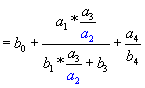 looking at a2
where we apply Rule 1(down->reciprocals current up and next up)

Furthermore, when b1=b3=1, it leads to

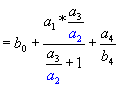
In both cases, the third terms are now untouched.
Its consecutive form

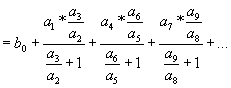
where the patterns of denominators are
101,101,101,…