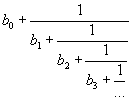
We consider the following:
where all the numerators {a1,a2,a3,…} are ones. We construct a continued fraction of x.
(1) Find b0 in x=b0+1/x1 where b0 is the largest integer that is less than or equal to x.
(2) Calculate the residual x-b0 and set it to 1/x1.
(3) Find b1 in x1=b1+1/x2 where b1 is the largest integer that is less than or equal to x1.
(4) Calculate the residual x1-b1 and set it to 1/x2 if it is not zero.
(5) If it is zero, stop there. Otherwise we repeat this for many times.
Example 
At first, b0=3.
The reciprocal of the rest is 1/0.14159265… that is 7.0625133…
Since the largest integer less than 7.0625133… is 7. That is b1=7.
The reciprocal of the rest is 1/0.625133… that is 15.996594… So we get b2=15.
The reciprocal of the rest is 1/0.996594… that is 1.0034172… So we get b3=1.
The reciprocal of the rest is 1/0034172… that is 292.63459… So we get b4=292.
We repeat this.
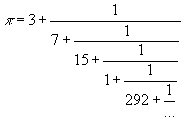
or we can denote it as [3;7,15,1,292,…].