

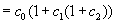

.
.
.
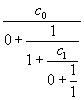
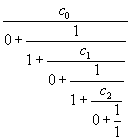
So we can say that

 in
special form
in
special form
Recall that the following consecutive form


in 0114. Now there is no b0 and a2,a4,a6, . . . are all ones. We get


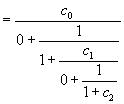
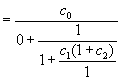
Thus


In the same way, we have
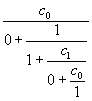


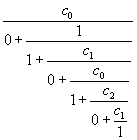
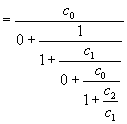
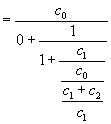
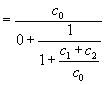


.
.
.
So we can say that

 in
special form
in
special form
where there is some pattern except the first two terms. Applying the same rule in 0114


and we get


Thus

