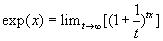
Conversion from exponential function to continued fraction
We know that
Recall that
 in special form
in 0225.
Regarding x=1/t and y=tn, it is going to be


As  , 1/t, 2/t,
3/t,. . . are all going to be zeros. So, we can say that
, 1/t, 2/t,
3/t,. . . are all going to be zeros. So, we can say that

Conversion from natural logarithm to continued fraction
We know that
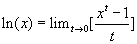
Recall that
 in
special form
in
special form
in 0225.

because the first one is subtracted from both sides. The first numerator is independent also in continued fraction, we can get

where the term of t is cancelled out.
As t->0,

Applying Rule 1(up->front) of signs in 0109, we get
 in special form
where all the negative signs are removed. Or, replacing x by 1+x, we get
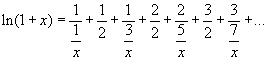 in special form
Applying gamma-shaped multipliers of x repeatedly,

Finally, we get
 in
special form
in
special form