Gauss's continued fraction
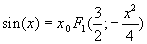
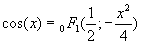
Trigonometric functions such as sin(x) and cos(x) are expressed in terms of 0F1(a;x).
That is
and
Recall that the following relation

in special form as in 0329. Since 3/2=1/2+1 when a=1/2, we can say that

after applying gamma-shaped multipliers of 1/2 repeatedly.
Thus
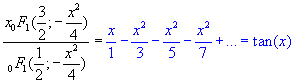 in special form
since sin(x)/cos(x)=tan(x). That is
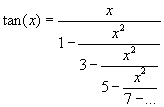
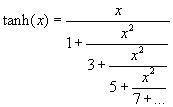
Similarly, we can do the same thing for tanh(x) from sinh(x) and cosh(x).
Hyperbolic functions such as sinh(x) and cosh(x) are expressed in terms of 0F1(a;x).
That is
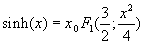
and
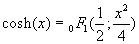
We use the same following relation

in special form as in 0329. Since 3/2=1/2+1 when a=1/2, we can say that
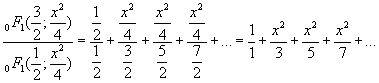
after applying gamma-shaped multipliers of 1/2 repeatedly.
Thus
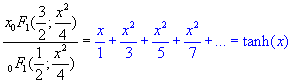 in special form
since sinh(x)/cosh(x)=tanh(x). That is,