Dynamic programming and Bellman Equation
We consider the following maximization problem with log utility function

subject to  and
and  .
.
We have the following switching parameters
 for
t=0,4,8,12,. . .
for
t=0,4,8,12,. . .
 for
t=1,5,9,13,. . .
for
t=1,5,9,13,. . .
 for
t=2,6,10,14,. . .
for
t=2,6,10,14,. . .
 for
t=3,7,11,15,. . .
for
t=3,7,11,15,. . .
for each quarter.
We can construct the following two Bellman equations




where value functions appear in order and go back to the first one.
We just guess




That is




Now we get FOC w.r.t. respectively. They are
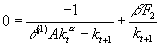
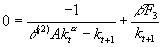
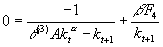
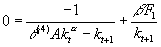
So
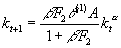 for
t=0,4,8,12,. . .
for
t=0,4,8,12,. . .
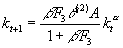 for
t=1,5,9,13,. . .
for
t=1,5,9,13,. . .
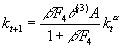 for
t=2,6,10,14,. . .
for
t=2,6,10,14,. . .
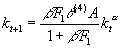 for
t=3,7,11,15,. . .
for
t=3,7,11,15,. . .
Plugging these four into Bellman equations at optimum, we get




They are




Comparing coefficients in each kind, we get


So
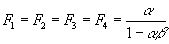
where the slope coefficients in value functions are the same.
The rest is




They are




where we can solve it numerically by plug them in order.
We solve out and we can say that the guess is right.
From the FOC’s, we have the following policy functions
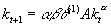 for
t=0,4,8,12,. . .
for
t=0,4,8,12,. . .
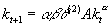 for
t=1,5,9,13,. . .
for
t=1,5,9,13,. . .
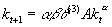 for
t=2,6,10,14,. . .
for
t=2,6,10,14,. . .
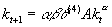 for
t=3,7,11,15,. . .
for
t=3,7,11,15,. . .
as in yesterday’s.