Dynamic programming and Bellman Equation
We consider the following maximization problem with log utility function

subject to  and
and  as in 0517.
We have the same following two parameters
 on
probability of p11 from state 1 to state 1 and p12 from state 2 to state 1
on
probability of p11 from state 1 to state 1 and p12 from state 2 to state 1
and
 on
probability of p21 from state 1 to state 2 and p22 from state 2 to state 2
on
probability of p21 from state 1 to state 2 and p22 from state 2 to state 2
where we suppose that they are given and constant. Here, p12=1-p11 and p22=1-p21.
Then, the corresponding Bellman equations are going to be

and

We just guess
 and
and 
That is


FOC’s w.r.t. are
are


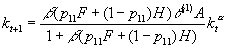 (*)
(*)
and

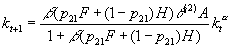 (**)
(**)
Plugging (*) and (**) into Bellman equation at optimum, we get






They are






Comparing coefficients in each kind, we get


They are


So


We could simplify further as

where they are the same as before.
The rest is
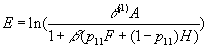


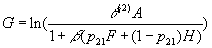


Then





Plugging the latter into the former, we get











We solve out and we can say that the guess is right.
From (*) and (**), we have
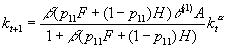
and
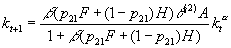
in terms of F and H. We may simplify them further. Actually, they are
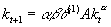
and
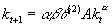
where they do not vary even though we have different probabilities.