Value function iteration
(1) Assume initials such as  .
.
(2) Calculate the next function 
(3) Calculate the next function  subject to
(4) Repeat the calculation  subject to
(5) Stop calculation if V converges or if we find its infinite form.
Let us set
x=k, u=k’, r( )=u( )=ln( ), and 
as in the maximization problem
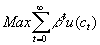 subject to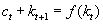
where

and

as in 0502.
Practically, we have the following steps:
(1) Set current value function and k’ to Bellman equation to calculate the next.
(2) Calculate FOC w.r.t. k’ and solve it for k’.
(3) Plug k’ into Bellman equation at optimum and arrange the terms.
(4) Repeat (1) through (3) until it converges.
We start with  and k’=0.
When j=0

Since  and k’=0

When j=1

That is

FOC w.r.t. k’ is
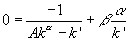

So

Plugging it into Bellman equation at optimum when j=1




When j=2

That is

FOC w.r.t. k’ is
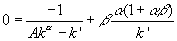

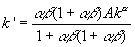
Plugging it into Bellman equation at optimum when j=2




.
.
.
We repeat this and we get

and

by induction when j=n.
Since 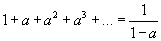 when 0<a<1
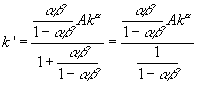
Thus

and in the same way we get
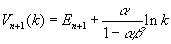
where we got the same things in the method of guess and verify.
Here, E’s are some constants we will calculate tomorrow.