Value function iteration
We consider the following optimization problem
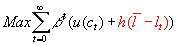 subject to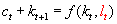
where we assume that  and
and 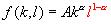 .
.
The corresponding Bellman equation is

We start with  and k’=0 as in what we did the day before yesterday.
When j=0

Since  and k’=0

On the other hand, FOC
w.r.t. l is
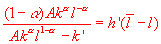
When k’=0
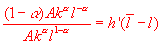
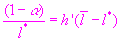
We have to solve
nonlinear equation for l*.
We then express

in terms of l*. We set it as

When j=1

That is

FOC w.r.t. k’ is
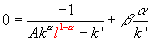

So
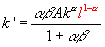
Plugging it into Bellman equation at optimum when j=1



On the other hand, FOC
w.r.t. l is
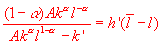
that is unchanged but k’ is changing. Plugging k’, we get
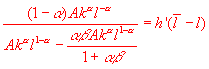
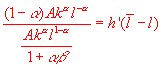
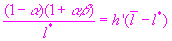
We have to solve the
nonlinear equation for l* again.
We can express as

in terms of l*. We can set

When j=2

That is

FOC w.r.t. k’ is
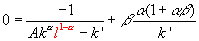

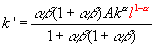
Plugging it into Bellman equation at optimum when j=2





On the other hand, FOC
w.r.t. l is
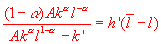
Plugging k’, we get
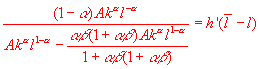
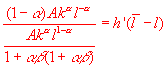

We have to solve the
nonlinear equation above for l*.
The left hand side is
going to change.
We can express


in terms of l*. We can set

.
.
.
We repeat this and we get


We have to solve the nonlinear equation above for l*.

by induction when j=n.
Since 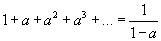 when 0<a<1
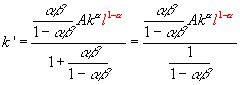
Thus
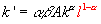
On the other hand,

Therefore
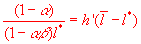
We have to solve this nonlinear equation for l*.
In the same way we get
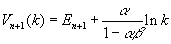
where we got the same things in the method of guess and verify.
The calculation of E is similar to yesterday’s
but using  .
.
When j=0

When j=1

When j=2

When j=3
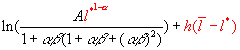

.
.
.
When j=n+1


Since 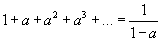 for 0<a<1
when we consider infinitely many terms
for 0<a<1
when we consider infinitely many terms
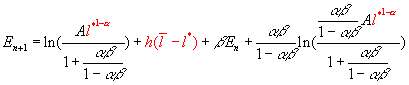
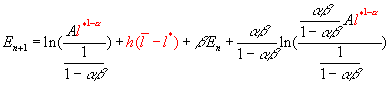
That is

Here, we can regard  and it converges
so we rewrite it as
and it converges
so we rewrite it as

Thus

where l* also approaches some constant value.